Moonshine Ink: Truckee Fire Sues Placer County Over Decades of Unpaid Property Tax
A 1970s land deal locked the district into a funding gap it says has grown to $40 million — and now a judge is letting the case move forward
By Alex Hoeft | alex@moonshineink.com
For decades, Truckee Fire Protection District has provided fire and emergency medical services to some of the region’s most affluent neighborhoods. According to the district, however, it has never received the full share of property tax revenue that should be tied to those responsibilities.
Now, after years of unsuccessful negotiations, Truckee Fire has taken Placer County to court, arguing that a decades-old property tax allocation error has deprived the district of roughly $40 million since the mid-1970s. The lawsuit could reshape how millions of dollars in property taxes are distributed among local agencies, drawing 10 other districts into the dispute.
Property tax collection for select special districts across Truckee/North Tahoe play a significant role in revenue streams. Some, like Truckee Sanitary District and Tahoe Truckee Unified School District, rely on property taxes for more than 60% of their operating revenue.
This is common in California: Revenue from the 1% property tax is the foundation for most jurisdictions, from counties and cities down to schools and special districts.
Which means if there’s a piece of the highly precious property pie tax missing, it doesn’t go unnoticed.
Nearly 75% of the Truckee Fire Protection District’s 2025/26 revenue comes from taxes, or $14.1 million of its total $19.8 million budget. That number, alleges the district, should be $4 million more.
The district officially brought a case before the Sacramento Superior Court in February 2025 to right a “historic wrong,” according to court documentation.
Placer County, through outside counsel, has so far called into question the legal validity of the entire case, disputing each of the four causes of action submitted by Truckee Fire that make up its argument. Judge Jennifer K. Rockwell ruled against the county’s claims as recently as May 14.
As of press deadline, the ball is in Placer’s court: it has until July 6 to file a formal response to Truckee Fire’s demand for court action and a legal ruling.
Because of the active litigation, both entities provided brief statements to Moonshine Ink:
“Truckee Fire looks forward to having our day in court and to an expeditious, fair, and complete resolution to this matter,” Chief Kevin McKechnie said.
“The county disputes the claims brought by the district and will defend its position in the litigation,” shared Steven Wilson-Maggard, public information officer.
How Did We Get Here?
The red tape that’s causing so much back and forth stems from California’s Proposition 13, passed back in 1978.
This ruling put a 1% tax rate cap of a property’s assessed value and limited yearly assessment increases to 2%. (Prior to ’78, the state’s average property tax rate was 2.67%.) Further, property reassessments bringing up a property to current market value can only take place when there’s a change in ownership or new construction.
Assembly Bill 8 (AB 8), enacted in 1979, determined how that 1% tax was divided up among local governments. County auditors were required to base this distribution on the average property tax revenue received by local governments in the few years preceding Prop 13.
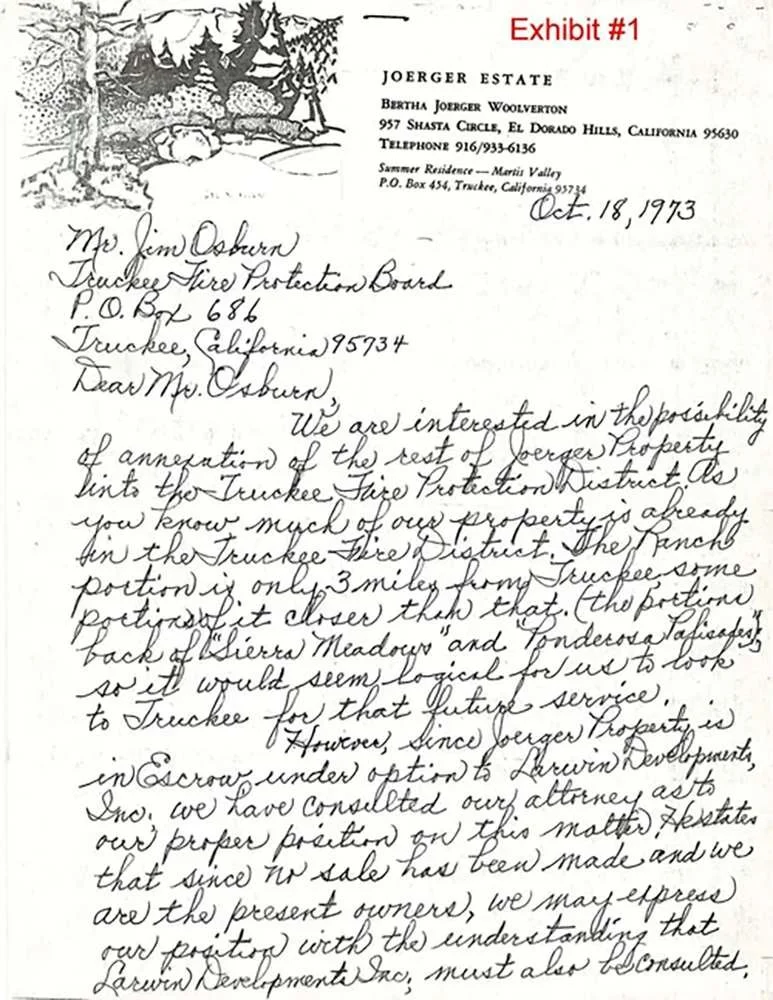
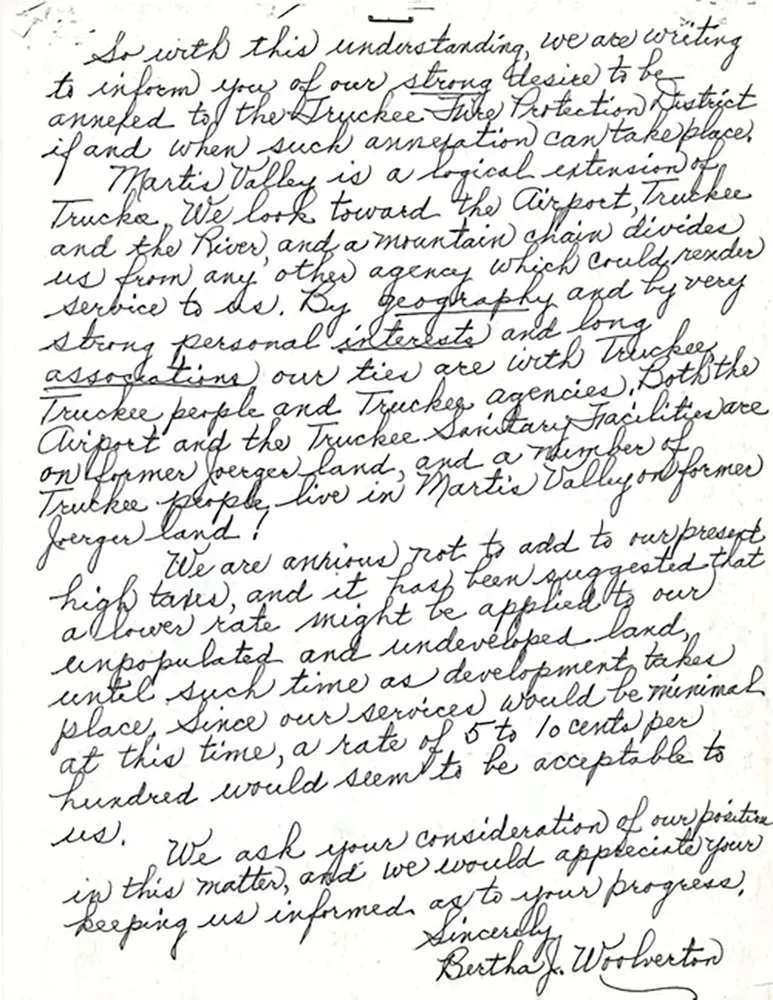
The crux for Truckee Fire is that a few years prior to Prop 13, the district began providing fire protection and medical services to a piece of land known then as the Woolverton Property and known now as Zone 7, annexed into the district in 1974.
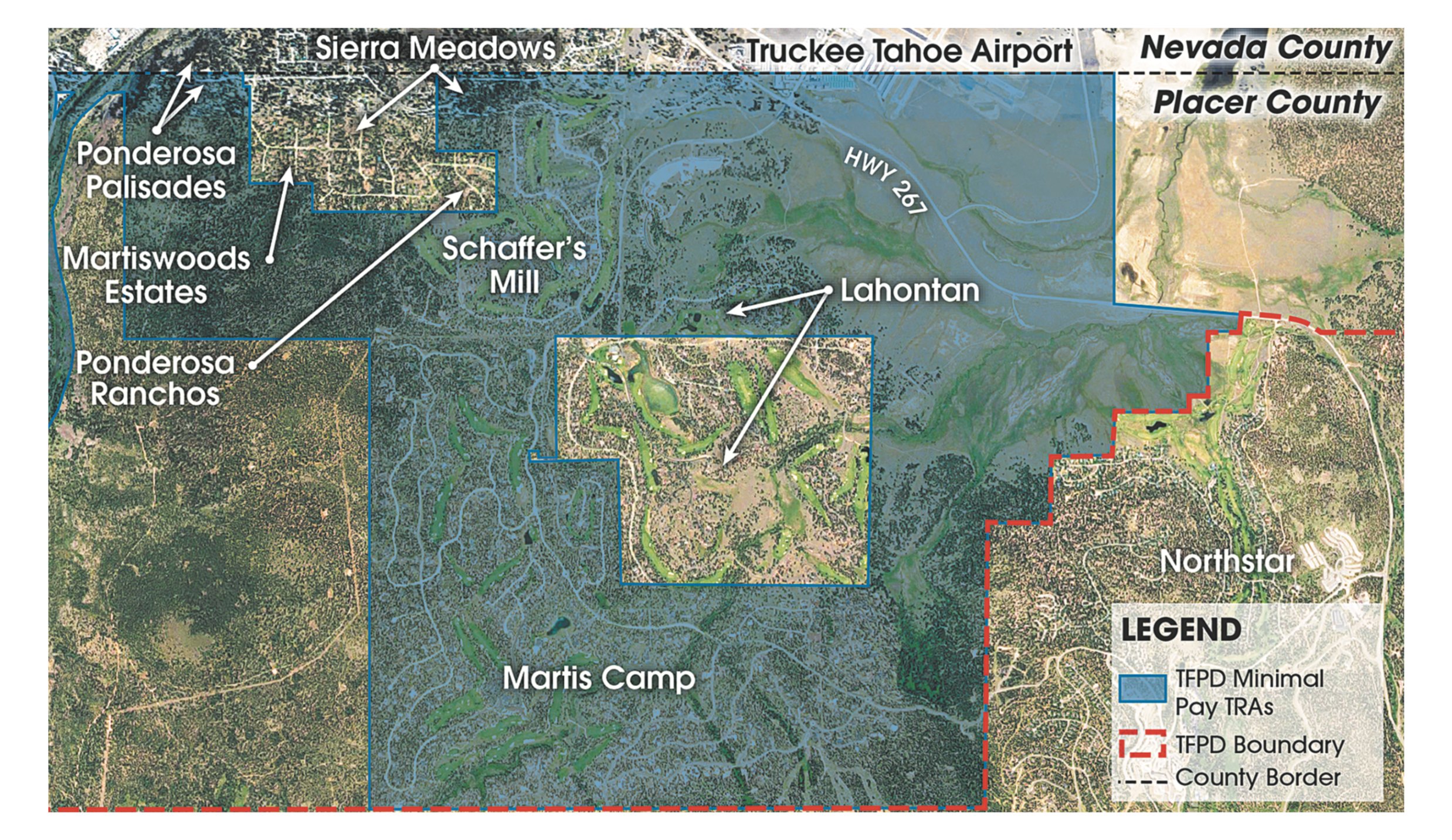
CAUGHT IN RED TAPE: Select neighborhoods in Martis Valley are classified as a No Pay Tax Rate Area (TRA), which means Truckee Fire Protection District provides service with no property tax revenue in return. The group of homes in question amounts to 1,600 structures across 2,189 parcels. Graphic by Lauren Shearer/Moonshine Ink and courtesy Google Maps
Zone 7 currently comprises Martis Camp, Schaffer’s Mill, part of Lahontan off Snowshoe Thompson Circle; a portion of Sierra Meadows off Pine Cone and Ponderosa drives, and Golden Pine Road; as well as a section of Ponderosa Palisades on Silver Fir Drive west of Thelin Drive.
The Woolverton agreement limited taxation to the value of improvements (or development), not the underlying land, and allowed property owner Bertha Joerger Woolverton “to continue to live on her property unburdened by taxes but to support the District’s services as she sold her land for development,” as stated in Truckee Fire’s complaint.
In board meetings, Placer County supervisors have called this deal of taxing Zone 7 at a reduced rate as a mistake made by Truckee Fire, leading to the district receiving only partial property tax from that area during three critical years before Prop 13. That taxation level was locked into place in 1978 — and has stayed that way through today.
During the 2024/25 tax year, across the TRAs in Zone 7, Truckee Fire received between 0.60% and 0.75% in AB 8 property tax allocation. A nearby TRA shows Truckee Fire receiving 11.58% of the distribution.
There have been some negotiations in the intervening years. Truckee Fire formally requested its share of AB 8 funding in 1997, 2011, 2018, and 2023. In 1997, Placer’s Auditor Controller Jayne Goulding sent a letter to Truckee Fire stating the revenues had been corrected, but that change never took place.
In 2019, the county allocated the district funding from an adjacent bucket: Placer County executed a voluntary tax share agreement allowing Truckee Fire to receive a portion of fire control fee collected from Zone 7 property taxes, amounting to about $300,000 annually. Truckee Fire considers this agreement irrelevant to the larger situation, according to court documentation.
In June 2024, the Placer County Board of Supervisors heard a presentation about the fire control fund and whether to continue with a subsequent funding method or not.
Placer County Supervisor Jim Holmes pointed out in June 2024 that Truckee Fire could have corrected the issue in part during the county’s 2003 general plan update but did not do so: “This sets a precedent … This takes money out of our general fund to supplement a district that failed to take action when the opportunity was there for them.”
The item was not up for action, and ended with unclear steps for the future. Eight months later, Truckee Fire filed its case.
What specifically is being asked for?
Truckee Fire’s legal reasons for suing Placer fall into two camps: three focus on the failure of property tax allocation (as described previously), while the fourth focuses on the county’s failure to comply with the Placer County General Plan and Martis Valley Community Plan.
This second camp claims the county approved real estate developments such as Martis Valley, Schaffer’s Mill, and part of Lahontan neighborhoods in Zone 7 without funding fire service in conjunction.
In early 2024, Truckee Fire alleges in the complaint, the district stated on an early building permit for a townhome development in Schaffer’s Mill that as the serving fire protection district, it would “withhold approval of a Certificate of Occupancy until it received adequate funding to provide fire services to the development.” The district also requested that the county restrict further development in Martis Valley until the funding issues at hand could be rectified.
On March 26 of that year, Placer amended its county code to allow fire-protection district approval to come from either Truckee Fire, Placer County Fire, or Cal Fire.
Over a year later, the Placer County Planning Commission modified the Schaffer’s Mill Conditional Use Permit language to allow either Truckee Fire or Placer County Fire’s signature for plan approvals.
Placer demurred to the district’s complaint on all causes of action. A demurrer essentially means that even if, in this case, Truckee Fire’s claims are true, they do not warrant a lawsuit. Judge Rockwell overruled two of the three demurrers, while sustaining the third demurrer on the fourth cause of action, but allowed the district time to amend its legal stance.
Truckee Fire did so, submitting an amended complaint — to which Placer demurred once again on the fourth cause of action. The judge overruled this demurrer in mid-May, leading to the current wait for Placer County’s response, due by July 6.
From there, the case will likely enter a discovery phase, during which both sides will exchange information, evidence, and witness interviews.
Among its requests for ruling, Truckee Fire hopes for legal mandates to the county to allocate and pay the district its AB 8 share of Zone 7 property tax revenue; a permanent injunction from denying Truckee Fire its AB 8 share; and a declaration that Placer’s decision to approve development in the Martis Valley area without general plan compliance violates the law.

TRUCKEE FIRE’S Station 96, serving the Martis Valley 24 hours a day, seven days a week since 2000. Courtesy photo
What other districts are involved (and whose side are they on)?
If Truckee Fire is allotted any amount of AB 8, which is a limited pot of money, other entities receiving property tax from Zone 7 will take a hit.
When it first filed its complaint, Truckee Fire did not include other taxing entities involved in Zone 7 who could be impacted. Placer called this out in a demurrer, requiring an amended complaint to include the following as real parties in interest:
Truckee Tahoe Airport District, Placer County Resource Conservation District, Tahoe Truckee Unified School District, Sierra Community College District, Placer County Office of Education, Placer County Water Agency, Tahoe Forest Hospital District, Tahoe Truckee Sanitation Agency, Tahoe City Public Utility District, and Truckee Sanitary District. All 10 are listed as parties on the side of Placer County.
Of the parties, the airport district, Tahoe City PUD, Tahoe Truckee Unified School District, Placer County Office of Education, and Truckee Sanitary District have filed joinders at some point, formally aligning themselves with Placer’s arguments. For the latest set of demurrers, the school district and office of education did not file joinders while the remaining three did.
Why other parties of interest didn’t file a joinder can be for many reasons, including being able to benefit from a decision without the cost or exposure; different interests than defendant’s strategies; and taking a wait-and-see approach.
“While the core of this dispute is between the fire district and the county, the legal remedy sought, a reapportionment of ad valorem property taxes, carries an outsized potential impact on a broad coalition of local public agencies that provide essential services to our community,” TTAD General Manager Robb Etnyre wrote in an email. “Because property tax revenue is a ‘zero-sum’ system under California law, any significant shift in these percentages means the funding must be drawn from the existing shares of other local entities.”
In its 2026 budget, TTAD anticipates receiving about $10 million in property tax revenue — about 55% of its revenue for the year.
Etnyre added that the airport district’s participation in the case, as well as the other parties with interest, “is intended to ensure that the pursuit of fire protection funding does not inadvertently destabilize the budgets of our schools, our hospital, or our regional infrastructure.”
Truckee Fire has said in public statements about the case, “Placer County would prefer we ask taxpayers districtwide to approve a new property tax so that the district can have sufficient funds to fund services in Lahontan, Martis Camp and Schaffer’s Mill … Placer County has already collected substantial tax revenue, they just need to allocate it.”
In the current court case, the district is requesting its AB 8 share from the date of the final court order forward. Meanwhile, it is also asking for historical records of what it received from 1975 to 1978, which would play a role in determining the full amount Truckee Fire might have collected since the mid-1970s.
View the article on Moonshine Ink